


|
Dieser Artikel oder Abschnitt muss überarbeitet werden, um den Qualitätsstandards des Fallout Wikis zu entsprechen. Du kannst helfen, indem du den Artikel verbesserst. → (Bitte stets erweitern und übersetzen, sowie wenn möglich, anhand von Belegen Inhalte stützen.) |
|---|
-->]]
 |
Dies ist ein Übersichtsartikel, der Hintergrundinformationen und unabhängige Spielvergleiche enthält. Spielspezifische Informationen und Statistiken sind in den verlinkten Artikeln auf der rechten Seite zu finden. |
|---|


The powered Infantry armor is the peak of armored infantry technology, initially developed in the West Tek Research Facility laboratories. Now, only the most technologically advanced factions with ties to pre-War military or government, such as the Brotherhood of Steel or the Enclave, have access to them, and only the latter possesses the technology required to manufacture new power armor models, such as the advanced power armor and advanced power armor Mk II.
The first version of power armor successfully deployed in combat was the T-45d model, which originally ran on small energy cells, burning through them at an alarming rate. In response, later versions were manufactured with built-in Microfusion Packs.
The most advanced pre-War model, T-51b power armor is fitted with a back-mounted TX-28 MicroFusion Pack which generates 60,000 Watts to power the HiFlo hydraulic systems built into the frame of the suit. Made of the poly-laminate composite, the T-51b shell is lightweight and capable of absorbing over 2500 Joules of kinetic impact. The 10 micron silver ablative coating can reflect laser and radiation emissions without damage to the composite subsurface.
T-51b power armor and later models also include a complete waste recycling system.
In one of the conversation with Ricky in the Fallout: New Vegas add-on Honest Hearts, it is revealed that the eyeslits of T-series power armor are bullet-proof.
The Chinese counterpart to power armor was the Hēi Guǐ stealth armor.
Hintergrund
- August 2065: The need for increased mobility among the units of the US Army Mechanized Cavalry leads the American government's defense contractors to focus their research on the development of a man-based tank - the ultimate result is powered Infantry armor.
- 2065 - 2067: Research and development into power armor intensifies among the different firms involved in the project and several prototypes are developed, many of which prove to be unworkable once they are deployed in the field. These prototypes pave the way for several major future advances in materials science, robotics, and nuclear fusion technology in the decade before the outbreak of the Great War.
- Summer 2066: The first crude nuclear microfusion cell is unveiled, one of the civilian technological spin-offs of the power armor project. The new technology is soon incorporated into a wide variety of consumer goods, including robots and automobiles. It begins to alleviate the terrible energy shortages plaguing the United States, but was unable to fully alleviate the world's energy problems before the outbreak of the Great War in 2077 made the problem moot. Ironically, had the fusion microcell technology had more time to disseminate across the globe from the United States, it would have solved most of the world's energy problems, thus ending the need for the armed conflicts that ultimately lead to the downfall of human civilization.
- 2067: The first suit of T-45d power armor is deployed for combat duty among American infantrymen fighting the Chinese occupation of Alaska. While lacking the full mobility of future versions of the armor, this early suit of power armor is incredibly effective against conventional Chinese tanks and infantry. Its ability to allow a single infantryman to carry heavy ordinance becomes key in various localized conflicts during the Sino-American War, and it has the power to destroy entire towns without endangering the wearer from attacks by conventional firearms or even missile launchers. The Chinese People's Liberation Army rushes to create its own versions, but the Chinese are many years behind the United States' work on the project.
- 2074: Contrary to the United States' claim of waging a defensive war that seeks only to retake Alaska from the Chinese, entire mechanized infantry divisions outfitted with power armor are deployed in an American invasion of China, but they become bogged down during intense combat on the Chinese mainland, putting a further drain on American resources and supply lines in the Sino-American War.
- June 2076: The T-51b power armor prototype is finally completed, resulting in the development of the suit of power armor that the Vault Dweller finds in Fallout. This suit represents the pinnacle of power armor technology before the outbreak of the Great War ends all technological progress for many decades. Many of these units are sent by the American military to the front in China, and they begin to carve a swath through the Chinese forces defending their nation, ending the stalemate that had defined the Chinese front of the war in the two years since the start of the American invasion. Chinese resources are strained to the breaking point by the new American offensive using the T-51b armor, and the supply lines from the nations China has annexed in East and Southeast Asia begin to break down.
- January 22, 2077: Power armor is used for the first time for domestic purposes within the United States by U.S. Army units deployed within American cities for crowd and quarantine control duties related to the growing resource shortages and outbreaks of epidemic disease. Units originally serving in China and on the Anchorage Front Line find themselves fighting fellow Americans at home as the disorders grow worse across the course of this year. Food riots increase, and many civilians are killed in fights with the military and police. A growing number of soldiers desert from the American military both in Canada and the United States. These deserters are captured when possible by military policemen and are sent to various military prisons across the United States. Some of these prisoners are later used by American military scientists in illegal human experiments at the Mariposa Military Base in California where the Forced Evolutionary Virus is first tested.
- 2198: The Enclave's scientists develop various new technologies, including the first new viable power armor variations since the Great War. None of these suits are much of an improvement over the original versions of power armor developed before 2077, and some are actually worse.
- 2215: Under Presidential Order, the Enclave's scientists begin to work on an upgraded version of power armor that exceeds the performance of the T-51b model. Many prototypes are developed and tested.
- October 2220: Enclave scientists finally develop a reliable version of what they call advanced power armor. The prototype's capabilities (and the various accidents/explosions/deaths involved in its creation) are classified by order of the Enclave's President Dick Richardson for the sake of the Enclave's morale.
- During 2242: After the destruction of the Oil Rig, the Enclave finished developing a Tesla power armor based on the standard advanced power armor, which was lower compared to the advanced power armor Mk II but made the operation of energy weapons by the wearer easier. This power armor is rare and never appears in the East due to the complete destruction of Navarro, which was the only remaining large base in the West.
Modelle
T-45d Powerrüstung

The T-45d power armor was the first version of power armor to be successfully deployed in battle by the United States in 2067 during the Sino-American War. The first version was powered by small energy cells and it burned through them at an alarming rate. Some later versions were either manufactured or retrofitted by the US Army with built-in microfusion packs, a technology that was developed later by West Tek.
While the T-45d armor is similar in its overall shape to the more advanced T-51b power armor, it is significantly less advanced than its later counterpart, and uses riveted steel plates instead of plastic composite materials in its construction. Various electronic and mechanical subsystems of the armor are exposed on the outside of its casing rather than sealed within as in the T-51b, making it far more susceptible to damage. In addition, a specialized body suit is required to be worn underneath the T-45d's armored shell in order to facilitate linking the armor's servos to the wearer's own motions and to make the armor more bearable because of its heat dissipation problems.
Vorkriegszeit-Varianten
- MP-47 prototype medic power armor - a power armor prototype has the ability to administer Med-X and features an on board voice module which is able to and will sound alerts if it detects an enemy presence. This armor was planned as an automatic medical supply dispenser, meaning troops would not have to be evacuated for medical treatment. It has the same appearance as the standard T-45d. It is also mentioned in its manual that it can administer a lethal dose of chemical substance to deserters, however this function had not been implemented in the early prototype stages.
Nachkriegszeit-Varianten
- Tribal power armor (Ashur's power armor) - a suit of power armor that was repaired and maintained over the years with parts from various sources and having taken a rusty yellow color, resulting in a unique looking, patchwork suit of power armor.
- Outcast power armor (Linden's Outcast power armor) - a suit of power armor with a black matte and rust red paint job, instead of the usual gray metallic, no other changes.
- NCR salvaged power armor - a very damaged suit was more or less restored by NCR engineers to working order. The joint servomotors have been removed, so in practice, this is just an armored suit crafted out of power armor.
- Scorched Sierra power armor -The Scorched Sierra power armor is a T-45d power armor that has been heavily modified by the NCR for its officers. Unlike NCR salvaged power armor, scorched Sierra power armor is still fully functional, retaining its servo-motors.
T-51b Powerrüstung

The T-51b powered Infantry armor represented the peak of armored infantry technology before the Great War, developed in the laboratories of the West Tek Research Facility in California. At the end of the Anchorage Reclamation in January 2077, the armor had become standard issue for American Soldiers in the Army's Mechanized Cavalry Regiments. Now, after the catastrophic events of the Great War, only the most technologically advanced factions with ties to the pre-Great War American military or federal government, such as the Brotherhood of Steel or the Enclave, have access to this type of power armor.
The armor is fitted with a back-mounted TX-28 MicroFusion Pack which generates an output power of 60,000 Watts to power the HiFlo hydraulic systems built into the frame of the suit. Made of a poly-laminate composite, the outer shell of the T-51b is lightweight and capable of absorbing over 2500 Joules of kinetic impact. The 10-micron-thick silver ablative coating can reflect laser and other radiation emissions without damage to the composite subsurface. The armor usually carries enough fuel to last for one hundred years.
Vorkriegszeit-Varianten
- Winterized T-51b power armor - the first model of T-51b deployed on the ground. It has snow-camouflaged paint that gives it an entirely metallic color. They were used during the Anchorage Reclamation to break enemy lines and infiltrate the primary compound of the Chinese General Jingwei who was the commander of the Chinese garrison force.
Nachkriegszeit-Varianten
- Hardened power armor - an improved T-51b which has undergone a special chemical hardening process for improving the defensive capability. It has the same appearance as the standard version.
- Brotherhood T-51b power armor - the T-51b used by the Brotherhood of Steel. It has an appearance almost identical to the Winterized T-51b except that the gray color tends more towards brown and the symbol of the brotherhood is present on the left pauldron.
Erweiterte Powerrüstung

The armor was created by the Enclave's skilled team of engineers and scientists after the Great War, as a result of a research program initiated in 2198, part of a larger project to develop various technologies. In 2215 the first actually superior suit is manufactured, entering service in 2220. Various accidents/explosions/deaths involved in its creation are classified by order of the Enclave's President Dick Richardson for the sake of the morale of the Enclave's personnel.
It is composed of lightweight metal alloys, reinforced with ceramic castings at key stress points. The motion-assist servo-motors used in the armor appear to be high quality models as well, giving the wearer a heavy increase to their Strength (+4). The suit has an auto-gyro system to keep it upright and the knees can be locked in position, to prevent the wearer from falling over, if, for some reason, he loses consciousness on duty (e.g. takes a nap).[1] Additionally, like the T-51b power armor, it includes a recycling system that can convert human waste into drinkable water, enhancing the ability to survive of the wearer.[2]
Erweiterte Powerrüstung Mk II

Like its older brother, the Mk II version is matte black with a menacing appearance, but with a few significant differences. It is composed entirely of lightweight ceramic composites rather than the usual combination of metal and ceramic plates, with a back-mounted power pack, instead of the built-in ventilated power unit of its predecessor.
Early versions used under the command of President Dick Richardson in 2241 used a similar design to the standard advanced power armor. However, following the destruction of the oil rig, the Enclave forces who made their way to the Capital Wasteland had redesigned its appearance by 2277, while keeping the "advanced power armor mk II" designation.
Tesla Powerrüstung Mk I

Unlike the pre-Great War Tesla armor, this armor is a variant of the Enclave's advanced power armor jury-rigged with a Tesla device that is capable of dispersing a large percentage of the damage done by directed-energy attacks. Additionally, the armor makes the operation of energy weapons by the wearer easier, boosting the Energy Weapons skill of the operator.
The only known suit of this type is the Gannon family Tesla armor.
Tesla Powerrüstung Mk II

This armor is a variant of the Enclave's advanced power armor Mk II jury-rigged with a Tesla device that is capable of dispersing a large percentage of the damage done by directed-energy attacks. Additionally, the armor makes the operation of energy weapons by the wearer easier, boosting the energy weapons skill of the operator.
Höllenfeuerpowerrüstung
This armor is the result of a post-War research project undertaken by the Enclave at Adams Air Force Base. It was one of several concurrent research projects, including one on duraframe eyebots and ended up being the only one to be fully completed; other projects, much to chagrin of researchers such as Whitley, were canceled in favor of the new model of power armor.
This heat-resistant type of power armor is used by specialized Enclave Hellfire troopers as well as a few regular Enclave soldiers.
Midwestern Brotherhood Powerrüstung
 | Die nachfolgenden Informationen basieren auf Fallout Tactics. |
|---|

This horned variant is used by the Midwestern Brotherhood of Steel, a splinter faction based in Chicago. Its origin is unclear (it's possible Chicago housed some special research facilities or had the means to produce such suits for the splinter faction).
Midwestern Brotherhood Erweiterte Powerrüstung
| Die nachfolgenden Informationen basieren auf Fallout Tactics. |
|---|

A more advanced version of the former, horned variant, composed of lightweight metal alloys, reinforced with ceramic castings at key points. Possibly upgraded by many Scribes, as there aren't many advanced power armors among the Brotherhood.
Vault-Tec power armor
 | Die nachfolgenden Informationen basieren auf Fallout: Brotherhood of Steel. Sie sind nicht Teil des Kanons. |
|---|
The origin of this armor is probably an attempt by Vault-Tec to produce some valuable combat equipment to help their own Secret Vault to successfully enter the post-apocalyptic world. It closely resembles the military's T-51b power armor.
Vault-Tec advanced power armor
| Die nachfolgenden Informationen basieren auf Fallout: Brotherhood of Steel. Sie sind nicht Teil des Kanons. |
|---|
A improve and unique advanced variant, it used the same design as the earlier version.
Athena power armor

An incomplete power armor project pioneered by the Enclave in conjunction with Poseidon Energy. According to initial tests, it had defensive capabilities above and beyond any other infantry armor in use before the apocalypse.
Vorkommen
Power armors appear in every Fallout game. T-51b power armor and its hardened version appear in both Fallout and Fallout 2 (and was to appear in Van Buren), while the latter also introduces the Enclave's advanced variants. In Fallout 3 the T-45d power armor is the general power armor that can be found, as most members of the Brotherhood of Steel wear it. The Enclave's variant suits of power armor are also encountered. A rusty set of T-51b power armor is located in the Fort Constantine military base (but can only be obtained by doing a specific quest), and a winterized version of the same model can be found in the Fallout 3 Operation: Anchorage add-on. In Fallout: New Vegas, It features the T-51b, the T-45d, while also bringing back the advanced power armor Mk1 from Fallout 2. It also adds a new version, The Tesla power armor Mk1. Quite inconsistently with previous games in the series, Fallout Tactics shows the T-51b model only once in the introduction of the game, and the Midwestern Brotherhood power armor, is used instead in the game, including a technologically more advanced version, years before the Enclave's new model is developed. In Fallout: Brotherhood of Steel, two version (regular and advanced) based on the T-51b with a similar appearance and a blue color appear in the Secret Vault, and are created by Vault-Tec. The power armor from the canceled Fallout d20 was a mixture of the T-51b model and the Fallout Tactics PA model.
Infos
- In Fallout 3, you must receive training at the Citadel from Paladin Gunny or complete the Operation: Anchorage add-on mission before you can equip power armor. Whilst being given the training, the Paladin tells the player to "relax their muscles" and "let the suit do the work". In Fallout: New Vegas, you must either complete Still in the Dark or For Auld Lang Syne.
- A number of companions, as well as non-player characters who may follow the Lone Wanderer, can equip power armor without receiving training.
- In Fallout: New Vegas all humanoid non-player characters can wear power armor, only the Courier must receive special training by the Mojave wasteland BoS chapter or the Enclave remnants to wear any and all types of power armor.
- In Fallout 3 and Fallout: New Vegas any weapon that is holstered on the player's or any non-player character's back is normally hanging off the right shoulder diagonally with the barrel downwards. However when wearing any form of power armor the gun is hanging diagonally off the left shoulder with the barrel pointing up. This is possibly because power armor prevents the arm movements neccessary to unholster the gun when it's in its normal position.
- In Fallout: New Vegas the player must receive Power Armor Training before they can utilize any form of the armor, except the NCR salvaged power armor, which is not really power armor in principle, as the motors were removed and replaced with a large backpack, which explains the large scale loss of Agility while wearing the bulky suits of armor.
- People will still know your identity even if you wear full power armor.
- In Fallout 3 and Fallout: New Vegas, any projectiles hitting the plating of power armors and power helmets react as if hitting a metal wall and do not cause blood, albeit still incurring damage. Instead there are sparks, solid sound instead of moist, fleshy sound, this is easiest to notice if one equips a companion with the armor and fires a Small Gun at them. Energy Weapons also react as if hitting a metal wall. This affects all characters, including the Player Character.
Quellen
- Powerrüstung Spezifikationen (engl.: Power armor specs)
Galerie
Fallout
-
Fallout concept art
-
 Box art
 -
A United States soldier in T-51b Powered armor
-
 A paladin of the Brotherhood of Steel
 -
 Cabbot, a scribe in training
 -
 US soldier executing a Canadian freedom fighter
 -
US soldier executing a Canadian freedom fighter
-
 Loading screen
 -

-

-


Fallout 2
-
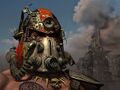 Tribal with a broken T-51b helmet
 -
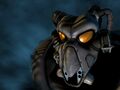 Advanced power armor
 -
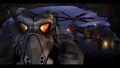 Enclave soldiers in advanced power armor
 -
 Enclave soldiers in advanced power armor in front of a pre-War poster depicting the T-51b power armor
 -
 Sargent Arch Dornan of the Enclave at Navarro
 -
 Enclave communications officer at the Poseidon Oil Rig
 -
 Frank Horrigan's customized power armor
 -

-


Fallout 3
-
T-45d power armor
-
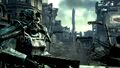 The T-45d power armor in the Fallout 3 teaser
 -
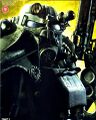 Brotherhood Paladin with a laser rifle
 -
A dead person in T-45d power armor in the Paradise Falls concept art
-
 T-51b power armor
 -
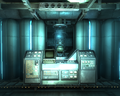 T-51b power armor in stasis
 -
An US soldier donned with power armor and a mechanic repairing a T-51b suit.
-
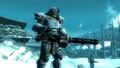 The US soldiers wearing the armor during the battle of Anchorage (zoomed in)
 -
 The winterized T-51b power armor from the Outcast outpost
 -

-
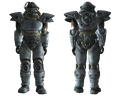 Winterized T-51b power armor
 -
 Brotherhood of Steel T-45d power armor
 -
Outcast T-45d power armor
-
Army T-45d power armor
-
Tribal T-45d power armor
-
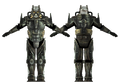 Enclave power armor
 -
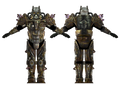 Tesla power armor
 -
Hellfire power armor


Fallout: New Vegas
-

-

-
 NCR salvaged T-45d power armor
 -

-
-
Brotherhood T-51b power armor
-
 Remnants power armor
 -
Tesla power armor Mk I


Fallout Tactics
-
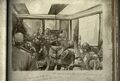 T-51b power armor
 -
T-51b power armor
-
Midwestern Brotherhood power armor
-
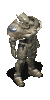


Van Buren
-
T-51b power armor
-
T-51b power armor
Fallout d20
-
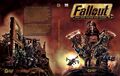
-

-
T-51b power armor advertising


.jpg)


_head_iix.jpg)
_2A.jpg)


.JPG)

.JPG)


Referenzen
Vorlage:Navbox Powerrüstung pl:Pancerz Wspomagany ru:Силовая броня