

| Datei:Mbox image.png | In diesem Artikel fehlt ein Bild. Du kannst dem Fallout-Wiki helfen, indem du eines hochlädst und auf der Seite einfügst. |
|---|


Synth ist eine Kurzform für synthetischer Humanoid und wird auch verwendet für Einheiten mit künstlicher Intelligenz, die Das Institut geschaffen hat, um auszusehen, zu handeln und sich zu verhalten wie Menschen. Ein veralteter Begriff, der besonders unter Dr. Zimmer verwendet wurde ist Androide oder Künstlicher Mensch. Synths kann man 2277 im Ödland der Hauptstadt und 2287 im Commonwealth und auf der Insel antreffen.

|
Dieser Artikel oder Abschnitt muss überarbeitet werden, um den Qualitätsstandards des Fallout Wikis zu entsprechen. Du kannst helfen, indem du den Artikel verbesserst. → (Reinigung) |
|---|
-->]]
Hintergrund
Synths, die vom Institut hergestellt wurden sind kybernetische Organismen, die geschaffen wurden, um stark dem Menschen ähneln. Sie werden in drei Generationen eingeteilt, die immer mehr an Komplexität gewinnen. Generation 1 Synths sind einfach nur robotische Androiden, die in etwa so intelligent sind wie ein Protektron sind und einem knochigem, metallischem Skelett mit mechanischen Organen und hydraulischen Muskeln. Generation 2 Synths sehen ähnlich aus, wie ihre Vorgänger, sind allerdings zäher und in "Fleisch" aus einem plastikartigen Material, dass auf dünnen Metallgittern aufgetragen wurde, gehüllt. Auch wenn sie schon wesentlich mehr wie Menschen aussehen, ist die Künstliche Intelligenz (K.I.) von ihnen noch sratk eingeschränkt und so wirken sie eher wie Puppen. Generation 3 Synths sind der Höhepunkt der Synth-Technologie. Man kann sie bis zu den Zellen nicht von Menschen unterscheiden, sind aber immer noch programmierbar und können durch verbale Befehle gesteuert werden.
Nick Valentine und DiMA sind einzigartige Prototypen eines Synths, die den Übergang zwischen den roboterartigen Generation 2 und den sehr menschenähnlichen Generation 3 Synths darstellen. Während DiMA so programmiert wurde, dass er seine Persönlichkeit anhand seiner Erfahrungen entwickelt, basiert Nick Valentines Persönlichkeit auf einem Detektiv, der vor dem Großen Krieg lebte und sich freiwillig dafür meldete, seine Erfahrungen und Erinnerungen zu kodieren. Dadurch hat Nick Valentine alle Erinnerungen seines Namenspatrons. Die beiden entkamen aus dem Institut, da aber Nicks Speicher für Erinnerungen nur klein ist, hat er dies wieder vergessen. Er geriet in einen Wutanfall, so dass DiMA nichts anderes übtig blieb, als ihn zurückzulassen. Später glaubt Nick, er wäre aus dem Institut verbannt worden. Irgendwann später reiste DiMA auf Die Insel, wo er zusammen mit Faraday eine Zuflucht für Synths, Acadia, gründete. Als auch DiMA seine Speicherkapazität erreichte, fing er an seinen Erinnerungsspeicher künstlich zu erweitern, indem er seine Erinnerungen auf verbundenen Computern und anderen Datenträgern speichert.
Auch wenn unbekannt ist, wann genau die unterschiedlichen Generationen entwickelt wurden, ist bekannt, dass die Bewohner von Diamond City im Jahr 2229 zum ersten mal einem Generation 3 Synth begegneten. Was zu dieser Zeit geschah sollte später als Zerbrochene Maske-Vorfall bekannt sein. Der Synth, der sich selbst Mr. Carter nannte, war ein Prototyp, der in einem Feldversuch getestet wurde, der nicht von dem Direktor des Instituts genehmigt wurde[1]. Auch wenn das Gemetzel an den Einwohnern von Diamond City vom Institut nicht gewollt war, fürchten die Bewohner Diamond Citys seitdem das Institut.
By 2277, at least one Generation 3 synth is known to have had traveled to the Capital Wasteland after becoming fully self-aware and escaping the Institute. With the help of the underground organization known as the Railroad, he had his appearance and memories altered, and eventually wound up as the chief of security at Rivet City. Incidents of synths escaping have occurred multiple times prior to 2277 as the Synth Retention Bureau was created and had multiple coursers tracking rogue synths as far as the Capital Wasteland.
Many denizens of the Commonwealth have become paranoid and prejudiced against synths, fearing they might be abducted by the Institute and replaced with identical copies of themselves. Their paranoia is justified, as some of the most sophisticated synths encountered act as spies and could fool the unaware. There are some examples of Commonwealth citizens that were murdered and replaced with synth duplicates whom the player character interacts with on missions if they choose to join the Institute.
The synths' Institute creators view them as nothing more than machines, and treat them as slaves. The Railroad has committed itself to freeing Generation 3 synths from their masters and smuggling them out of the Commonwealth to somewhere the Institute cannot reach them. In contrast, the Brotherhood of Steel has sworn to eliminate all synths, for to them, a machine capable of thinking like a human is an abomination of technology.
Most encountered hostile synths belong to either Generations 1 or 2, are armed with Institute laser weapons and shock batons and are immune to radiation damage. When fighting against the Gen 1 and 2 synths, it is possible to shoot off their limbs. This can come in handy if there are too many of them, as the moment one of their arms is destroyed, they may be unable to use their weapons. However, they will then proceed to rush the player character and begin attacking them with their remaining arm. Shooting their legs will result in them crawling to the player character and attacking them with their hands.
Gen 1 and 2 synths are less intelligent than Gen 3 synths, but display a level of sapience, as exemplified in their dialogue. They call out to their target "whoever you are, I know you're there," and will comment that their systems may be in need of recalibration if they lose track of a target. During the Tradecraft quest, Deacon comments that Gen 1 and 2 synths are on a similar mental level to protectrons and other pre-War robots, causing some debate among members of the Railroad as to if Gen 1 and 2 synths are worth trying to rescue.
Generation 3 synths are physically and mentally indistinguishable from ordinary humans, having lab-grown bodies of real human flesh, bones, and organs instead of plastic and metal. As Dr. Roslyn Chambers found, no medical tests or procedures can out someone as a synth without killing them (synths that infiltrate settlements, for example, only drop synth components when killed), and psychological tests, such as Covenant's SAFE test, are dubious at best. Like humans, synths are susceptible to radiation poisoning[Prüfung überfällig], and ballistic damage. However, they are not perfect duplicates, and have a few key differences from humans that are not immediately obvious: synths do not age, nor can they gain or lose weight (one Institute researcher remarked on this after discovering that many of the Institute synths had a taste for snack cakes). There are many Generation 3 synths that are hidden in plain sight in the Commonwealth. They include, but are not limited to, Magnolia, the singer of the Third Rail, and Danse, a paladin of the Brotherhood of Steel.
Gameplay
While most Synths are Gen 1 or Gen 2 and are thus allied to the Institute, synths can also be encountered in other places.
If the player character has built a radio beacon, incoming settlers have the potential to be Gen 3 synths (non-infiltration). This can be observed by picking the Perception perk Awareness (requires 3 points), and targeting settlers in VATS. Synth settlers will have 10 energy resistance and 10 radiation resistance by default, subtracting any bonuses from apparel. If these settlers are put on a supply line and happen to pass any major Brotherhood of Steel encampment (Cambridge, etc.), they will be fired upon by the entire station, stalling any building the player character can do.
Synths can also be a part of a Minutemen patrol, if the Sole Survivor has retaken the Castle and has an ample amount of well-off settlements. Again, this can be observed through VATS and the Awareness perk. Strangely, if a Minutemen patrol that possesses these synths passes a Brotherhood encampment, they will not be fired upon. Sometimes their patrol routes take them straight through the Boston Airport, into the courtyard of Fort Strong, and back through again. They will not fire upon each other and will sometimes pleasantly engage in dialogue with each other.
If the player character has established a bad reputation with the Institute (in other words, completing the quest Banished from the Institute), the Sole Survivor's settlements will often be infiltrated by synths who will eventually open fire on the player character's other settlers. While at first they can be hard to spot, they have subtle characteristics that set them apart from other "normal" synth settlers.
- They do not sleep, even though they have a bed "assigned" to them, and will do their assigned job all throughout the night.
- A synth component can be taken out of the trade window or pickpocketed, as opposed to having to kill them like normal synth settlers.
As a couple days pass, the "settler" will open fire on other settlers and will become hostile to the player character and their companions. This is one of the few instances where a character can kill one of other settlers.
This will be a rare occurrence after the Institute is destroyed.
Varianten
Synth
Weak and disturbingly human-like, the generic synth poses little threat to low level player characters. Even so they are rarely found solitary and often come in groups of four or so. Armed with Institute weapons they are one of the cheapest ways of attaining large amounts of power cells. Like ghouls, their limbs can be removed and they will change their tactics accordingly. Vorlage:Stats creature FO4 Vorlage:Stats creature FO4 Vorlage:Stats creature FO4
Synth strider
Stronger than an ordinary synth, these striders, while fairly weak, are still a significant step up. They, like their counterparts, use almost exclusively institute weapons, though there are exceptions where they will use shock batons. Likely by the point one meets these enemies they will already replace a good percentage of the synth enemies the player character meets. Take caution as with most synths they almost always travel in decently sized groups. Vorlage:Stats creature FO4 Vorlage:Stats creature FO4 Vorlage:Stats creature FO4
Synth leader
Stronger than most synths, Leaders can pose a dangerous enemy for the unprepared. Unlike most synths, leaders are armored and possess heavily modified institute weapons. They almost exclusively travel with other synths and usually act as the final opponent in synth occupied areas. Those of low level or who have armor specced towards anti ballistic weapons may find these opponents somewhat troublesome. Vorlage:Stats creature FO4 Vorlage:Stats creature FO4 Vorlage:Stats creature FO4
Synth patroller
A step up from the synth Strider, this variant of synths is stronger and has a better aim. They are usually seen in groups of other synths, such as synth Striders or synth Leaders, and are usually seen with Institute pistols or rifles.
| Datei:FO76 icon overlay wait 02.png | Dieser Abschnitt ist erforderlich, wurde aber noch nicht geschrieben. Du kannst dem Fallout Wiki helfen, indem du ihn schreibst. |
|---|
Lua-Fehler in Modul:Abb, Zeile 708: attempt to index field '?' (a nil value)
Vorlage:Stats creature FO4 Vorlage:Stats creature FO4 Vorlage:Stats creature FO4
Synth seeker
Higher and stronger then the synth patroller, these synths can really pack a punch. Seen with other higher variants of synths, these types can be dangerous with other Synths. Usually seen with the same weapons as the synth patroller.
| Datei:FO76 icon overlay wait 02.png | Dieser Abschnitt ist erforderlich, wurde aber noch nicht geschrieben. Du kannst dem Fallout Wiki helfen, indem du ihn schreibst. |
|---|
Lua-Fehler in Modul:Abb, Zeile 708: attempt to index field '?' (a nil value)
Vorlage:Stats creature FO4 Vorlage:Stats creature FO4 Vorlage:Stats creature FO4
Synth trooper
Synth Troopers are the backbone of the synth reign. They are a little more aggressive than most of their counterparts and usually spawn in weaker packs of synth Striders or occasionally Patrollers. Proceed with caution. Vorlage:Stats creature FO4 Vorlage:Stats creature FO4 Vorlage:Stats creature FO4
Synth assaulter
| Datei:FO76 icon overlay wait 02.png | Dieser Abschnitt ist erforderlich, wurde aber noch nicht geschrieben. Du kannst dem Fallout Wiki helfen, indem du ihn schreibst. |
|---|
Lua-Fehler in Modul:Abb, Zeile 708: attempt to index field '?' (a nil value)
Vorlage:Stats creature FO4 Vorlage:Stats creature FO4 Vorlage:Stats creature FO4
Synth stormer
A really high level of the synth variants, these type of synths can be really deadly if unprepared. Seen with stronger variants of other synths.
| Datei:FO76 icon overlay wait 02.png | Dieser Abschnitt ist erforderlich, wurde aber noch nicht geschrieben. Du kannst dem Fallout Wiki helfen, indem du ihn schreibst. |
|---|
Lua-Fehler in Modul:Abb, Zeile 708: attempt to index field '?' (a nil value)
Vorlage:Stats creature FO4 Vorlage:Stats creature FO4 Vorlage:Stats creature FO4
Synth eradicator
The strongest variant of synth, and one of the deadliest enemies in the game. Equipped with the best Institute weaponry and having high damage resistance. Vorlage:Stats creature FO4 Vorlage:Stats creature FO4 Vorlage:Stats creature FO4
Bemerkenswerte Synths
Fallout 3
Fallout 4
- Amelia Stockton
- Art
- Aster
- B2-57
- Brooks (L7-92)
- Captain Avery
- Chase
- Cog
- Cole
- Curie (after Emergent Behavior; originally G5-19)
- Paladin Danse (M7-97)
- Dejen
- Derrick
- DiMA
- F6-33
- Faraday
- Gabriel (B5-92)
- Glory (G7-81)
- H2-22
- Jule
- Jules
- K1-98 Jenny
- Magnolia (possibly C2-41)
- Miranda
- Mayor McDonough (M7-62)
- Naveen
- Nick Valentine
- Roger Warwick
- Shaun (S9-23)
- Sturges - based on game files, no in-game dialogue indicators
- High Confessor Tektus (after Reformation)
- Timothy
- X4-18
- X6-88
- X9-27
- Y9-15
- Z1-14
- Z2-47
- Z3-22
Notizen
- In Fallout 3 sind die Synths unter dem Namen "Androiden" bekannt. Aufzeichnungen auf Vaters Terminal erklären den Wechsel der Bezeichnung.
- Nachdem man einen Synth zerstört hat, kann man dennoch sehen, wie die Augen dieser Einheit sich weiterhin bewegen. Dies scheint nach einer Enthauptung aufzuhören.
- Schon frühe Synth Modelle wie Nick Valentine und DiMA können riechen.
- Wenn man die Bezeichnung des Instituts für Synths betrachtet, ist es möglich 67600 Synths mit unterschiedlichen Namen zu erstellen.
- Generation 1 und 2 Synths sind von betroffen von dem legendären Effekt "Troubleshooter", wohingegen Generation 3 Synths von dem "Assassin's"-Effekt betroffen sind.
Vorkommen
Synths kommen in Fallout 3 und Fallout 4 vor. Die zwei Synths, denen man in Fallout 3 begegnet, Armitage und Harkness sind wahrscheinlich Synths der Generation 3. Damit wurden Synths der Generation 1 und 2 nicht bis Fallout 4 bekannt.
Hinter den Kulissen
- Synths share many similarities with the terminators from the Terminator film franchise. The most notable one being that the Generation 1 synths are nothing more than endoskeletons that loosely resemble a human skeleton, just like the majority of terminators created by SkyNet. The Generation 2 synths differ in that they possess artificial skin like the T-600 terminators shown in Terminator Salvation. The Generation 3 synths were designed to look exactly like human beings so that they can infiltrate human settlements undetected, which is the exact purpose of the T-800 infiltrator seen in every Terminator film. Sometimes when in combat with Gen 1 and Gen 2 synths, they will say to the player character "You must be terminated." Finally, the biggest similarity is that both the Fallout and Terminator franchises depict a post apocalyptic America destroyed by nuclear war.
- The Generation 3 synths are quite similar to the Replicants from Blade Runner, based on the novel Do Androids Dream of Electric Sheep?, in that they are synthetic humans genetically engineered entirely out of organic substances and are virtually indistinguishable from real human beings. The author, Philip K. Dick explored ideas of different types of conscious beings as equal with humanity, and the human reaction to these rival sentient beings. This is one of many Blade Runner references throughout the game. In fact, the surname "Deckard," if used in some way as part of the player character's name, is one of the names that Codsworth is capable of saying. This is a reference to Rick Deckard from the film. In addition, the test required to enter Covenant measures psychological response to random questions, very similar to the exam that Blade Runners give to suspected Replicants.
- The hunting of rogue synths somewhat references the movie Artificial Intelligence. The movie depicts a futuristic America where androids are used as servants for various jobs, but they commonly gain self awareness and run away only to be hunted down and destroyed.
- The exact distinction between Gen 1 and Gen 2 synths is a little vague. In the games files there are three types of non Generation 3 synths, not two. Some are unambiguously Gen 1 synths and spawn with a completely exposed mechanical skeleton and typically do not use armor, as seen in Kellogg's memories during Dangerous Minds. On the other hand, some are unambiguously Gen 2 synths and have intact "skin" which can only be damaged by crippling their limbs, expressive faces, and typically wear clothes, such as the synth requisition officer. In between these are synths with rigid plastic skin, which typically spawn at least partially damaged and can be blasted off by the player character even without crippling limbs, similar to other robots. The last group could represent Gen 2's that have begun to decay, but given the more rigid appearance of their skin, they appear to be an earlier model. It could be that Gen 1 synths may have been built with plastic casings that often degraded over time and some units simply have none left.
- Gen 2 synths bear similarities to the NS-5 robots from the film I, Robot.
- Synths may be based on Star Trek's Androids. Both have human variants such as Data and Gen-3 Synths. There is controversy on what to call them, Androids or Synths, Synths being short for Synthetic Humans. Both have controversy as to whether they are people or not, as Data, at one point, was threatened to be dissected and used to create more, saying he is not a person. Synths have the Railroad and East Coast Brotherhood of Steel, and they both have someone they call Father, for Data it is the scientist who created him and Lore. For the Synths, it is Shaun, who was essential in creating 3rd Gens.
Galerie
Synths in Fallout 3
-

-
 Armitage, Dr. Zimmer's bodyguard in 2277


Synths in Fallout 4
-
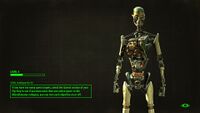 A Generation 1 synth
 -
 A damaged Generation 2 synth
 -
 Different Gen 2 synth damage stages
 -
 Concept art
 -
 Synth Gen 1 and 2 concept art
 -
 Concept art
 -
 Modified synth DiMA in the Far Harbor trailer


