

Der Mond ist ein Himmelskörper, der in der gesamten Fallout-Reihe zu sehen ist.
Geschichte
Am 16. Juli 1969 landete im Rahmen der Mission Valiant 11 erstmals ein Team der United States Space Administration mit dem Virgo-II-Mondlandefahrzeug auf dem Mond. Damit waren sie die ersten Menschen, denen dies gelang.[1][2] Am 14. November desselben Jahres brachte die Mission Valiant 12 das Virgo-III-Landefahrzeug auf den Mond und hinterließ vor dem Abflug die Nationalflagge der Vereinigten Staaten auf der Mondoberfläche.[3]
Im Jahr 2020 erfolgte die Inbetriebnahme der Delta-IX-Raketenreihe durch die United States Space Administration. Mit diesen Raketen fanden mehrere Missionen zum Erdtrabanten statt, darunter die 17-tägige Mission Zeus 12.[4] Im Jahr 2052 fand die letzte bemannte Mission zum Mond statt. Dabei wurde die von Valiant 12 zurückgelassene Flagge geborgen und zur Erde zurückgebracht, wo sie schließlich im Technischen Museum in Washington, D.C. ausgestellt wurde.[3]
Es gibt Berichte, dass amerikanische Streitkräfte im Mare Tranquilitatis auf der Mondoberfläche gekämpft haben, um die Freiheit der Nation zu schützen.[5] Die Punktetafel der  Fallout 76-Saison Kampf um die Freiheit zeigt Soldaten in Weltraumspaziergang-Powerrüstungen, die eine amerikanische Flagge auf der Mondoberfläche hissen. Im Hintergrund sind eine Mondbasis und darüber fliegende Raketen, die der Delta IX ähneln, zu sehen. Mitgebrachtes Mondgestein wurde auf der Erde offen zum Verkauf angeboten.[6]
Mondphasen

Die Mondphasen ergeben sich aus der Gestalt des unmittelbar von der Sonne beleuchteten Teil des Mondes, der von der Erde aus sichtbar ist. Sie verändern sich im Laufe der Zeit allmählich und wiederholen sich regelmäßig. Dies lässt sich in allen First-Person-Spielen der Fallout-Reihe direkt am Himmel beobachten. Ein Mitglied der Erleuchteten erwähnt mehrere Mondphasen, darunter der Dreiviertelmond, der abnehmende Halbmond und der Neumond.[7]
Zitate
Vorkommen
Der Mond erscheint in allen Fallout-Spielen, ist aber erst ab  Fallout 3 sichtbar. Zudem wird er in Fallout 3,
  Fallout: New Vegas, Fallout: New Vegas, Fallout 76, der
  Fallout Bible und
  Van Buren erwähnt.
Hinter den Kulissen
- In einem Entwicklerkommentar zu
 Fallout 2 hieß es, dass das Garten-Eden-Erstellungs-Kit sogar die Mondoberfläche bewohnbar machen könnte, wenn das Land zuvor entsprechend vorbereitet würde.[Non-game 1]
 - Der Ort wurde in den Entwurfsdokumenten für das abgesagte Van Buren-Projekt erwähnt.[Non-canon 1]
Galerie
-
 Nahaufnahme des Mondes auf dem Lucky-38-Poster aus dem Intro von Fallout: New Vegas
 -
 Über der Interstate 15 im Mojave-Ödland
 -
 Der Mond scheint über Jacobstown in Fallout: New Vegas
 -
 In der Abenddämmerung in der Mojave
 -
 Der Mond im Nebel über dem Commonwealth
 -
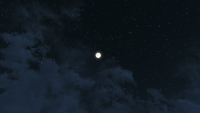 Der Mond am Nachthimmel in
 Fallout 4
 -
 In Appalachia
 -
 Über den Bergen in Appalachia
 -
 Über Appalachia
 -
 Ein Wandgemälde im Museum der Freiheit in Fallout 4, das einen Astronauten zeigt
 -
 Guns and Bullets: The Moon: A Communist Doomsday Device?!
 -
 Live and Love: An Experience to Remember!
 -
 Errungenschaftsbild Wish upon a Star
 -

-

-

-
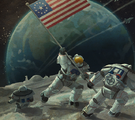 Scoreboard-Grafik der Saison Kampf um die Freiheit


Referenzen

|
Dieser Artikel oder Abschnitt wurde teilweise oder vollständig aus dem Independent Fallout Wiki übernommen. Du kannst VAULTPEDIA helfen, indem du ihn übersetzt. |
|---|
- ^ Museum of Technology terminal entries; museum information, exhibit guide, spaceflight exhibits
- ^ Museum of Technology placard: "On July 16, 1969, the Virgo II Lunar Lander 'Valiant 11' became the very first manned space vehicle to touch down on the Moon. The Valiant 11's crew consisted of Captain Richard Wade, Captain Mark Garris and Captain Michael Hagen of the USSA. We salute these brave and noble men who took the very first steps on a planetary body other than our own."
- ↑ 3,0 3,1 Museum of Technology placard: "This unusual flag was recovered from the surface of the moon by the very last manned flight to its surface in 2052. The flag is from the old 'Valiant 12' Virgo III Lunar Lander that touched down November 14, 1969. It's remarkable condition can be attributed due to its construction; the flag is actually made of special materials to withstand the harsh environment of space."
- ^ Museum of Technology terminal entries; Delta IX rocket, Delta IX rocket information
- ^ Placard in the Museum of Freedom: "This mural commemorates the many sacrifices of the brave men and women of the United States Armed Forces. From Lexington and Concord to the shores of Iwo Jima, from the Sea of Tranquility to the Anchorage Front Line, Americans have fought and died through the ages to secure our nation’s freedom. May their sacrifices remind us all that freedom is a privilege afforded to the many, yet hard won by a noble few."
- ^ H&H Tools factory terminal entries; Dobson O'Gill's terminal; E-Mail from Jenny DeSoto
- ^ Observations, vol. XXVII
- Non-game
- ^ Fallout Bible 6: "The GECK isn't really a replicator. It contains a fertilizer system, with a variety of food seeds, soil supplements, and chemicals that could fertilize arid wasteland (and possibly selected sections of the moon's surface pre-conditioned to accept the GECK) into supporting farming. The GECK is intended to be 'disassembled' over the course of its use to help build communities (for example, the cold fusion power source is intended to be used for main city power production), and so on. Anything else people needed, they could simply consult the How To Books/Library of Congress/Encyclopedias in the GECK holodisk library for more knowledge. The pen flashlight was just a bonus."
- Non-canon
- ^ Boulder design documents, p. 2: "Supported by money from Denver's industry and an active military presence, Boulder scientists made advances in medicine (bio-med gel was invented here), alternate energy sources, robotics, and even developed a power armor prototype. Unfortunately, leakage from the Rocky Mountain Arsenal (a nearby toxic waste dump/weapons storage location) caused a poisonous cloud that killed a lot of people in Denver. As an apology, the military funded a program to create a self-sustaining research dome, capable of withstanding a nuclear attack. This 'city of the future' was to be a prototype for settlements on the moon and other planets."