

| Zeile 11: | Zeile 11: | ||
Ghule oder nekloide-post Menschen sind heruntergekommene, faulende, zombie-artige Mutanten. Sie wurden Opfer der hohen radioaktiven Strahlung, die ihre Körper vergiftete und ihre Haut zerfrass und, paradoxerweise, dafür sorgt, dass sie unter den Bedingungen des Ödlands bestens üerbleben können. | Ghule oder nekloide-post Menschen sind heruntergekommene, faulende, zombie-artige Mutanten. Sie wurden Opfer der hohen radioaktiven Strahlung, die ihre Körper vergiftete und ihre Haut zerfrass und, paradoxerweise, dafür sorgt, dass sie unter den Bedingungen des Ödlands bestens üerbleben können. | ||
==Beschreibung== | ==Beschreibung== | ||
Wenn Menschen über eine längeren Zeitraum radioaktiver Strahlung ausgesetzt werden kann es auf Grund eines unbekannten genetischen Defekts zur Transformation bzw. Mutation in einen Ghul kommen. Seltene Fälle wie in Camp Searchlight zeigen, dass eine schnelle Ghulifizierung nicht ungewöhnlich ist. Normalerweise folgt auf eine schwere radioaktive Verstrahlung Erkrankung mit anschließendem Tod. Manchmal führt die Verstrahlung auf Grund des genetischen X-Faktors zur Ghulifizierung und somit zum Überleben der verstrahlten | Wenn Menschen über eine längeren Zeitraum radioaktiver Strahlung ausgesetzt werden kann es auf Grund eines unbekannten genetischen Defekts zur Transformation bzw. Mutation in einen Ghul kommen. Seltene Fälle wie in Camp Searchlight zeigen, dass eine schnelle Ghulifizierung nicht ungewöhnlich ist. Normalerweise folgt auf eine schwere radioaktive Verstrahlung Erkrankung mit anschließendem Tod. Manchmal führt die Verstrahlung auf Grund des genetischen X-Faktors zur Ghulifizierung und somit zum Überleben der verstrahlten Person. Die genauen Gründe hiefür sind weiter unbekannt. | ||
Version vom 13. April 2012, 22:47 Uhr

|
Dieser Artikel oder Abschnitt muss überarbeitet werden, um den Qualitätsstandards des Fallout Wikis zu entsprechen. Du kannst helfen, indem du den Artikel verbesserst. → (Weicht erheblich von den Infos im engl. Wiki ab. Wird bald umgeschrieben, wer es sich zutraut, kann dass auch gern übernehmen, auch Passagenweise gern gesehen.) |
|---|
-->]]


Ghul
“Die Zukunft. Überleben überall. Wir übertreffen den Standart."” -Set über die Ghule
Ghule oder nekloide-post Menschen sind heruntergekommene, faulende, zombie-artige Mutanten. Sie wurden Opfer der hohen radioaktiven Strahlung, die ihre Körper vergiftete und ihre Haut zerfrass und, paradoxerweise, dafür sorgt, dass sie unter den Bedingungen des Ödlands bestens üerbleben können.
Beschreibung
Wenn Menschen über eine längeren Zeitraum radioaktiver Strahlung ausgesetzt werden kann es auf Grund eines unbekannten genetischen Defekts zur Transformation bzw. Mutation in einen Ghul kommen. Seltene Fälle wie in Camp Searchlight zeigen, dass eine schnelle Ghulifizierung nicht ungewöhnlich ist. Normalerweise folgt auf eine schwere radioaktive Verstrahlung Erkrankung mit anschließendem Tod. Manchmal führt die Verstrahlung auf Grund des genetischen X-Faktors zur Ghulifizierung und somit zum Überleben der verstrahlten Person. Die genauen Gründe hiefür sind weiter unbekannt.
Most known ghouls in the Core Region were created from vault dwellers living in Vault 12 under Bakersfield, known as Necropolis after the Great War, located in southern California. As part of the vast Vault Experiment Program, the Vault 12 door was designed to not close properly. Radiation from nuclear detonations and the subsequent fallout contaminated the vault, resulting in the death or mutation of every occupant. Now, they can be found in small amounts throughout this region, most of which are in Gecko, a town established near an old, half-functional Poseidon Energy nuclear power plant. Many could also be found in Broken Hills, an old town located near a uranium mine, typically inhabited by humans, super mutants and ghouls. However, the uranium was eventually depleted and the town was abandoned sometime after 2242.
Ghouls from other regions most likely originated from opportune or home-made shelters. Such shelters were not adequate to fully protect against all the effects of nuclear fallout. Radiation levels in some areas were such that they were low enough not to kill people, but high enough not to leave them unscathed. There are ghouls in the Midwest, most notably a nuclear weapon-worshipping cult in Kansas City. Both Quincy and Springfield also have at least some ghoul occupants. In Texas, most of the former residents of Los Ybanez, known as Los after the Great War, have become ghouls, probably remaining blocked at the entrance of the Secret Vault. Later, in the same city, the Church of the Lost was created by former vault dwellers of the Secret Vault that had become ghouls.
In the Capital Wasteland, many ghouls currently alive were born long after the Great War in 2077 and succumbed to radiation poisoning much later, due to the high levels of radiation in Washington, D.C. and its surroundings for decades following the fall of the bombs. The majority of intelligent ghouls in the Capital Wasteland have chosen to settle in Underworld, a settlement established in the Museum of History in the ruins of The Mall. The settlement got its name from the exhibit on mythological representations of the afterlife in which the ghouls established their town.
In the Mojave Wasteland, they can be found in small amounts throughout the region, but no town is completely dedicated to them. There are usually a few ghouls living among humans in various communities performing jobs in order to survive, such as the guard Beatrix Russell, and the comedian Hadrian, both of which are in Freeside. The only known community of ghouls in the region is the Bright Brotherhood, a religious faction located in the REPCONN Test Site, founded and lead by an intelligent glowing one named Jason Bright, who wants to leave Earth and go into space to find a "new world", a promised land foretold by Bright. There are also several ghoul rangers occupying Ranger station Echo, implying some level of acceptance of ghouls serving in the NCR.
Diskriminierung
Since the war, more people have had run-ins with ghouls, both civil and feral. Because of the animalistic behavior and savage threat feral ghouls pose, many people view all ghouls negatively. For example, the residents of Tenpenny Tower refuse to let ghouls into their luxurious hotel, despite polite offers of caps. Chief Gustavo is particularly bigoted and feels that "they'll all go feral one day." Negative stereotypes about ghouls stem from wastelanders who couldn't care less that all ghouls are not feral. Terms like "zombie," "shuffler," or "brain eater" are common insults. Because of this general negativity, some ghouls, such as Roy Phillips and Mister Crowley, have developed a bitter hatred of humans.
It appears ghouls are better accepted in New Vegas, however, appearing more frequently as equals, sometimes serving in the NCR or acting as prostitutes.
Verwirrung über die Entstehung
There is some controversy, even among the makers of Fallout games, about the origins of ghouls. While Tim Cain said explicitly that ghouls are only a result of radiation, consistent with an understanding of the science of radiation as it stood during the 1950s, Chris Taylor said that a mix of both radiation and FEV was involved. While Chris Avellone initially supported the latter view in his Fallout Bible,[1] he was later convinced to support the radiation-only version.[2] Some people believe that ghouls were formed when the bombs fell, people who were not fortunate enough to be in a vault or die were exposed to the radiation and became ghouls.
Biologie
Ghouls created in the Great War of 2077 are still alive during Fallout (2161), Fallout 2 (2241), Fallout 3 (2277), and Fallout: New Vegas (2281). All ghouls live considerably longer than normal humans, though they are sterile. The reason for this longevity has to do with differences on the cellular level, and the ability of ghoul DNA to regenerate at a rate unmatched by normal human nucleic acids. Occasionally, in a ghoul, additional genetic material is added as a result of the mutation.[3] The unnaturally long lifespan of a ghoul is also due to a mutation within the autonomic nervous system of certain individuals following exposure to specific combinations of ionizing radiation with wavelengths below ten picometers. Radiation that has such a short wavelength, less than ten picometers, is known as gamma radiation and is normally lethal to healthy humans in even moderate doses. The mutation in response to gamma radiation that produces ghouls disrupts the normal process of decay in the neurotransmitters along the spinal cord.
Ghouls were not created immediately after the Great War in 2077; the process took months or years for some. After a few weeks, their skin slowly started to flake off and crack. In Fallout 3, Carol explains that even after the War it took a while for the ghouls to start looking like they do now. However, there have been occasions when ghouls are made instantly by large doses of radiation. For example, Camp Searchlight, where an entire base of NCR soldiers were transformed into feral ghouls by a radioactive device used by Caesar's Legion, and the ghoulification of Moira Brown after the warhead in Megaton was detonated by the Lone Wanderer (if the player chooses to do so).
Although lacking strength due to decayed tissue, ghouls have heightened senses making them more perceptive and lucky than other wasteland humanoids. As a result, chems like jet barely affect them. Doctor Barrows, when healing the player, bemoans the fact that "You humans are so fragile."
Specifically, the neurotransmitters affected in a ghoul's mutation are those responsible for cardiac and respiratory function in a healthy human being. These transmitters are continually regenerated at a greatly accelerated rate after the mutation sets in, carrying sufficient oxygen to sustain the life of the subject while being insufficient to retain dermal elasticity and avoid the resulting necrosis (much like the disease leprosy), the result of which is the decaying, corpse-like appearance of post-mutation humans. Old ghouls may also still suffer from some of the debilitating effects of old age however as some of the two centuries old ghouls like Raul Tejada and Dean Domino complain of knee problems when made to crouch, and both of them were far from elderly when they became ghouls. Raul also mentions how he's no longer as swift and agile as he used to be in his youth, though this might be psychosomatic and caused by Raul's continuous doubts about his age and place in the world. Still these may indicate that their regenerative abilities' problems with skin could extend to other soft tissues of their joints.
In physical appearance, a ghoul's flesh is constantly rotting off, appearing very raw and discolored from necrosis. Lips and eyelids are sometimes absent, and noses are in almost every case completely rotted off. Feral ghouls are typically heavily emaciated and hunched over (possibly due to malnutrition and lack of sunlight), while non-ferals typically have a heavier, more human-like build and posture. Another major difference between ferals and non-ferals is dress: while non-ferals dress like normal humans, feral ghouls wear little clothing other than tattered pants or sections of old armor, having lost the mental capacity to mend or replace their clothes long ago.
Ghouls, at least the non-feral ones, are generally as intelligent as normal humans. However, their physical repulsiveness makes the life of a ghoul difficult at best - only the most tolerant human communities accept them as anything more than monsters. Some ghouls eventually go mad and it remains unclear exactly what precipitates this change in neurobiology and psychology, but anecdotal evidence seems to indicate that non-social ghouls, or those in isolation, are more prone to the condition. It is also quite possible that this is a gradual process, meaning that eventually all ghouls would succumb to this condition. However, considering the number of ghouls who have lived for more than two centuries, it is quite possible that this is not so, or that the rate of degeneration is dependent on the individual affected and surrounding environmental factors. Ghouls that succumb to insanity are called "feral ghouls:" they are mindlessly aggressive and, having lost their ability to reason, driven entirely by their instincts. These feral ghouls strongly resemble zombies like those depicted in old horror films, and this misconception succeeds in alienating non-feral ghouls even more from humans. The term "zombie" has become an offensive racial slur to ghouls and "smoothskin" is a derogatory term for humans often used by ghouls.
Ghouls are immune to most forms of radiation that still remain in the Wasteland. Radiation poisoning cannot get worse for the ghouls, though it can hasten the process of decay and lead to their decline into the feral state as described above. However, many ghouls report feeling healthier when exposed to low-level radiation, and thus make their homes near locations with acute background radiation. The ghouls known as "glowing ones" actually enjoy large amounts of radiation, which they describe as being "comfortably warm." They are even healed by it.
As one of the more common consequences of ghoulification seems to be sporadic or even complete hair loss and loss of their normal voice: few ghouls retain enough hair on their heads to actually maintain a haircut, and ghouls with facial hair seems to be even more rare. Also, ghouls with a clear voices are very uncommon. Desmond Lockheart from the Point Lookout and Raul Tejada from Fallout: New Vegas are two of the few examples of ghouls with facial hair, and Plik from Point Lookout and Jason Bright from Fallout: New Vegas are two examples of ghouls with a clear voice.
Varianten
A feral ghoul===Feral ghoulsBearbeiten=== Main article: Feral ghoulFeral ghouls are among the more unfortunate mutants whose minds have deteriorated from prolonged radiation poisoning, becoming instinct-driven savages, attacking anyone and anything relentlessly, save for other ghouls. Wearing the ghoul mask in Fallout 3 makes all feral ghouls ignore the player unless directly assaulted. Despite what Roy Phillips says, no matter how close you get to a feral ghoul when wearing the ghoul mask, they will not "Sniff you out," and become hostile.
Wandernder Wilder Ghul
Main article: Feral ghoul roamerRoamers are less common feral ghouls dressed in worn-out sections of old combat armor, giving them greater damage resistance. The armor does not, however, slow them down; in fact, they are slightly faster than regular ferals. They typically can be found alongside two or three ferals, and attack in groups. Alone they are still weak and easily brought down with most weaponry, but they can easily flank the player during a group attack.
Glühender
Main article: Glowing oneThese ghouls have absorbed so much radiation they glow a ghastly green color in the dark. They are known as "glowing ones," and are often considered outsiders even by other ghouls. The glowing ones can sustain a lot more damage than other ghouls, second only to reavers (see below). They also emit radiation from their whole body, and can even release a devastating blast of energy from their bodies at will, healing nearby ghouls and harming unlucky attackers caught in the blast radius.
People have seen on more than one occasion a feral glowing one fighting or being chased by "normal" feral ghouls. Although very rare, it is possible for a glowing one to retain their intelligence and cognitive functions, such as Jason Bright.
Plündernder Wilder Ghul
Main article: Feral ghoul reaverThis rare flavor of ghoul, dressed in the rusty remnants of metal armor, appears in both Mojave Wasteland and the Capital Wasteland through the Fallout 3 add-on Broken Steel. They also appear frequently in the swamps of Point Lookout. A greenish smoke issues from their scars, and their flesh appears to be melted and even bubbling in some areas, as if being "cooked" by the radiation they have absorbed. In Fallout 3 they are among the toughest enemies in the game, able to take a direct hit from a Fat Man and survive. Besides being incredibly fast and having a deadly swipe, they can pull chunks of radioactive gore from their guts and hurl it at the player with deadly accuracy. In Fallout: New Vegas, reavers are much weaker and lack the ability to throw gore, making them much easier to handle.
Intelligente Ghule
An intelligent ghoul, CharonIntelligent ghouls have suffered far less mental degradation from their condition and retain their full faculties from before their transformation. These ghouls possess the ability to talk, and they normally wear clothing, as well as carrying and using weapons. Some may have hair on their head, but not a lot. Some male ghouls, such as Raul Tejada, may even be lucky enough to retain some semblance of facial hair, similar to Desmond in the Fallout 3 add-on Point Lookout, with hair on both his head and face. They normally have a low, gravely and rather raspy voice, most likely due to damage to their vocal chords from a combination of radiation and necrosis. Jason Bright, an intelligent glowing one, from Fallout: New Vegas has a normal voice, although it has an odd echoing quality to it, as do Dean Domino and Raul Tejada. If Megaton is destroyed in Fallout 3, Moira Brown has a similar, but notably different voice effect. Regular ghouls walk normally, unlike ferals, which hunch over. The majority of them are not hostile and will not attack without provocation. Ghouls often refer to humans as "smoothskins." These ghouls also find terms such as "shuffler" and "zombie" to be offensive.
Gezeichnete
Main article: Marked menSkinned alive when the warheads of the Divide went off, and turned into ghouls by the resulting radiation of the warheads, marked men suffer from a unique form of ghoulification only seen in the Divide. The injuries they suffer from would mean the death of an ordinary ghoul, and the radiation of the Divide is believed to be the only thing keeping them alive.
Geborene Ghule
Main article: Born ghoul
| The following is based on Van Buren and has not been confirmed by canon sources. |
Through cruel experimentation on humans by Dr. Sebastian at the Reservation, Born ghouls were created. They are ghouls who were not mutated humans, but who were actually born into ghoul-dom.
| [1] | End of information based on Van Buren. |
|---|
Wissenswerte Notizen
- There ain't any ghouls but old ghouls. We're all sterile, see, but we're incredibly long-lived. We're the first and last generation of ghouls. - Typhon
- Without medical technology, all of us ghouls are going to die off in the next 20 years, anyway. - Gordon (Gordon dialogue file)
- [Say, how do you make a ghoul?] With silver-bells and cockleshells and… Boy, you are dumb, aren’t you? Severe radiation. That’s how. How do you think? You know, many bombs go boom, flash of light and heat, flesh burns off, but you don’t-quite-die-type severe radiation? - Wooz (Wooz dialogue file)
- [How's it going?] Not bad, still in one piece... well except for that one that got away, but I'll find it, no worries. -Patchwork
- I don't have to tell you that Bright's group has got some fine-looking ghoulettes in it! Eh... or maybe I would have to tell you... - Harland
- It could happen to you too, you know. - Underworld resident
Ein Ghul oder auch nekrotische post-humane Menschen sind altersschwache, verwesende Zombie-ähnliche Mutanten. Sie sind Opfer von schweren Verstrahlungen, dessen Haut erodiert und paradoxerweise, erheblich ihr Leben erweitert . Ghule waren Menschen, die durch große Hitze und Strahleneinwirkung mutierten. Sie altern viel langsamer als richtige Menschen und sind bei den meisten Kreaturen nie gern gesehen.
Herkunft
Ghule waren Menschen, die nicht die Gelegenheit hatten, sich in eine Vault zu begeben. Dadurch bekamen sie die gesamte Hitze und Strahlung ab, als die Bomben fielen.
Die Enklave erforscht neben Todeskrallen und Supermutanten in ihren Labors in Raven Rock auch Ghule. Sie könnten entweder versuchen Ghule zu Kampfzwecken nutzbar zu machen, wie sie es mit Todeskrallen getan haben, oder versuchen den Ursprung der "Ghulifizierung" zu ergründen.
Strahlenbelastung für einen längeren Zeitraum, verursacht manchmal bei Menschen mit einem unbekannten genetischen Merkmal eine Verwandlung zum Ghul, obwohl in seltenen Fällen, wie dem von Camp Searchlight zeigen, dass schnellere Transformationen in Ghulen nicht unbekannt sind. Die Aussetzung von radioaktiver Strahlung läuft normalerweise auf die Strahlenkrankheit hinaus, gefolgt vom Tod für den durchschnittlichen Menschen, der genetische X-Faktor, der zu Veränderung in einem Ghul auf die Aussetzung statt des typischen tödlichen Ergebnisses führen wird, bleibt jedoch weiterhin unklar.
Die meisten bekannten Ghule in der Kern-Region wurden von Vault Bewohner leben in erstellt Vault 12 unter der Stadt von Bakersfield, Kalifornien (besser bekannt als Nekropole nach dem Weltkrieg). Als Teil der großen Vault Experiment Programm, der Vault 12 Tür wurde entwickelt, nicht richtig zu schließen. Die Strahlung aus der Fallout und nukleare Explosion kontaminierten der Vault, was zu vielen Toten und Mutationen führte..
Verwirrung über Ursprünge
Es gibt eine Meinungsverschiedenheit sogar unter den Schöpfern von Fallout-Spielen über die Ursprünge von Ghulen. Während Tim Kain ausführlich sagte, dass Ghule nur ein Ergebnis der radioaktiven Strahlung sind, weil im Einklang stehend mit einem Verständnis der Wissenschaft der Strahlung stand es während der 1950er Jahre, sagt Chris Taylor sagte, dass eine Mischung sowohl der Strahlung als auch ein Erzwungenes Entwicklungsvirus im Spiel war. Während Chris Avellone am Anfang die letzte Ansicht in seiner Fallout Bibel[1] unterstützte, war er später überzeugt, die Nur-Strahlung-Version zu unterstützen.[2]
Lebensraum
Wilde Ghule leben im ganzen Ödland verstreut. Intelligente Ghule (wie z.B. Gob in Megaton) durchwandern das Land oder leben in Städten genau wie normale Menschen.
An der Westküste gibt es zwei bekannte Ghulstädte, Necropolis unter der Kontrolle eines Ghuls namens Set, der für seine unfreundliche Art mehr oder weniger bekannt ist und Gecko unter der Führung von Harold, einen sympathischen Ghulänlichen Mutanten. Die Ghule in DC versammeln sich in großen Zahlen in Underworld, einer Ghulstadt unter DC. Einige jedoch wollen unter Führung von Roy Phillips in den Tenpenny Tower, um dort zu wohnen. Wieder Andere versuchten Old Olney als Ghulstadt aufzubauen, wurden aber Opfer von Todeskrallen, die in ungewöhnlich großer Zahl dort leben. In Mama Dolce's findet man eine große Ansammlung von ehemaligen Chinesischen Soldaten, die durch mangelnden Schutz vor der Strahlung zu Ghulen wurden. Im Dunwich Gebäude, welches von einer großen Menge wilder Ghule bevölkert wird, findet man eine Gruppe Ghule die auf der untersten Ebene einen Obelisken anbeten. Wilde Ghule sind die am häufigsten anzutreffenden Gegner in den Metrotunnels des Ödlands der Hauptstadt und scheinen allgemein dunkle Orte im ganzen Ödland zu bevorzugen.
Fakten
Die meisten Ghule sind in der Regel genauso intelligent wie Menschen, was ihr Aussehen jedoch nicht unbedingt vermittelt. Daher verabscheuen viele Menschen die Ghule, besonders die Ansässigen vom Tenpenny Tower. Ghule sind größer als ein weisser Mann, das kann man besonders gut sehen, wenn man Charon als Gefolgsmann hat.
Ghule altern langsamer als normale Menschen. Es gibt sogar Vorkriegs-Guhle. Das sind Menschen, die den Weltkrieg überlebt haben, aber sich aufgrund der Strahlung in Ghule verwandelten, es trotz allem jedoch geschafft hatten existent zu bleiben. Carol ist ein gutes Beispiel dazu. Sie erinnert sich zwar nicht mehr an allem, erzählt aber, dass sie als kleines Mädchen die Bomben hat fallen sehen.
Die Ghule sind völlig immun gegen Strahlung. Einige empfinden diese sogar als angenehm. Jedoch zersetzt die Strahlung langsam ihr Gehirn, woraufhin sie sich in wilde Ghule, streuende wilde Ghule, plündernde wilde Ghule oder Leuchtende verwandeln können, welche ihre Fähigkeit, normal zu denken, völlig verloren haben, so dass sie alles und jeden angreifen, der selbst kein Ghul ist oder zumindest nicht wie einer aussieht. Ghule werden auch durch Strahlung geheilt. Vermutlich deshalb gibt es in der Klinik von Underworld einen Raum in dem zwei Leuchtende herumlaufen. Der Spieler kann diesen Raum nicht betreten.
Die Supermutanten und die Ghule haben keine feindliche Beziehung, sind allerdings auch keine Verbündeten. Anscheinend können die Supermutanten nicht das gleiche mit den Ghulen tun, was sie mit den Menschen machen, die sie gefangen nehmen. Sie haben also keinen Nutzen an Ghulen und greifen diese deshalb nicht an. Trägt der Spieler die Ghulmaske werden sie ihn dennoch angreifen.
Galerie
Fallout und Fallout 2
-
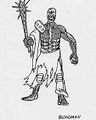 Bloodman - Eine frühe Konzeptzeichnung für Fallout
 -
 Ein Guhl aus Fallout
 -
 Ein Leuchtender aus Fallout
 -
 Ein Guhl aus Fallout 2


Fallout 3
-
Ein Wilder Guhll
-
Die tragbare Ghul Maske
Fallout Tactics
-
Fallout Tactics ghoul concept art
-
 Fallout Tactics ghoul model
 -
 A ghoul in Superior ghoul armor render


Fallout: Brotherhood of Steel
-
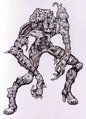 Glowing one concept art for Fallout: Brotherhood of Steel
 -

-
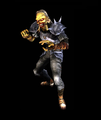 Another shot of Cain
 -
A ghoul render of Fallout: Brotherhood of Steel


Fallout d20
-
Ghoul from Fallout d20
Fallout: New Vegas
-
Raul, ein Ghul Begleiter.
-
Jason Bright, ein freundlicher Leuchtender.
-
Pvt. Kyle Edwards, ein vor kurzem ghulifizierter Soldat.
Fallout Online
-
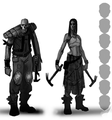 Male and female ghoul concept art.


